Showing posts with label Love. Show all posts

Wednesday, March 5, 2014

Book Review: Paul Miller - A Loving Life

A few years ago, Paul Miller’s book, A Praying Life, earned nearly universal praise for his theologically rich and immensely practical prose of the subject of prayer. Now, Miller has brought those same qualities to bear in his new book, A Loving Life. I expect the praise will be wide-ranging for this book as well.

Focusing on the book of Ruth, Miller uses this woman’s story to unpack much of the Biblical meaning of hesed, the Hebrew term typically translated steadfast love or something similar. It combines the ideas of love and loyalty, and Miller spends page after page showing the superiority of hesed love over and against what our culture typically thinks of when it thinks of love. The beautiful story of Naomi, Ruth, and Boaz shows us how God loves and how we are to love.

Miller writes:
Hesed is opposite of the spirit of our age, which says we have to act on our feelings. Hesed says, “No, you act on your commitments. The feelings will follow.” Love like this is unbalanced, uneven. There is nothing fair about this kind of love. But commitment-love lies at the heart of Christianity. It is Jesus’s love for us at the cross, and it is to be our love for one another.

The book is saturated with this kind of wisdom, along with real-life, practical examples of people both failing and succeeding in living out hesed. For marriages, friendships, family relationships, business relationships, etc., the Christian is to love with this kind of outward-looking, self-forgetting, loyal love. The vision painted in this book is absolutely beautiful, and it will inspire many to change how they view the people God has placed around them and seek to love God and others more in line with the Biblical view of love...hesed.

Wednesday, November 14, 2012

Do You Love Controversy or People?

Jim Hamilton:
There is no conflict between loving truth and loving people. You really can love people as you obeyTitus 1:9, which says an elder should “hold firm to the trustworthy word as taught, so that he may be able to give instruction in sound doctrine and also to rebuke those who contradict.” You can even love people as you follow Jude’s appeal that you “contend for the faith that was once for all delivered to the saints” (Jude 3). 
A few years ago I would have been suspicious of anyone who mentioned the need to engage in theological controversy in a loving way. I would have done one of those mental clucks of the tongue and inched the person toward the “needs-to-firm-up-conviction” column. 
As time has passed, though, I’ve participated in a few controversies (many connected to the sovereignty of God in salvation or the roles of men and women) and I’ve watched some controversialists take issue with views that I hold. Obviously I haven’t been in all these battles, only a skirmish or two, and sometimes I found myself wondering if those involved loved God, people, and truth, or just loved controversy. 
I don’t muse on that possibility because of a softening of my own convictions, nor because I don’t like to mix it up, because I’m tired of the fight, or because I think my views worsted. The question arises because some of the caricatures have seemed so obvious I wondered whether they were intentional. The controversialists surely should have known they were fighting misrepresentations, and I am certain that they would not want their views treated the way they treat those they attack. 
I found myself thinking things like this: You’re using the name of the view I hold, but you’re not describing anything like my understanding of it. Only an idiot or a monster would hold it the way you describe it. You know you’re attacking a straw man, right? 
This line of though led me to wonder whether the controversialists were concerned for me as a brother in Christ. I began to ask whether they loved me, because if they really loved me, they would want to help me see the benightedness of a position they thought was so awful, they would want to liberate me from the bondage of bad ideas, and their desire to help me in these ways would surely cause them to use a different tone of voice and a better method of argumentation.

Wednesday, September 12, 2012

We Are Lovely Because We Are Loved

Martin Luther, from the Heidelberg Disputation, #28:
#28 - The love of God does not find, but creates, that which is pleasing to it. The love of man comes into being through that which is pleasing to it. 
The second part is clear and is accepted by all philosophers and theologians, for the object of love is its cause, assuming, according to Aristotle, that all power of the soul is passive and material and active only in receiving something. Thus it is also demonstrated that Aristotle's philosophy is contrary to theology since in all things it seeks those things which are its own and receives rather than gives something good. The first part is clear because the love of God which lives in man loves sinners, evil persons, fools, and weaklings in order to make them righteous, good, wise, and strong. Rather than seeking its own good, the love of God flows forth and bestows good. Therefore sinners are »attractive« because they are loved; they are not loved because they are »attractive«: For this reason the love of man avoids sinners and evil persons. Thus Christ says: »For I came not to call the righteous, but sinners« (Matt. 9:13). This is the love of the cross, born of the cross, which turns in the direction where it does not find good which it may enjoy, but where it may confer good upon the bad and needy person. »It is more blessed to give than to receive« (Acts 20:35), says the Apostle. Hence Ps. 41:1 states, »Blessed is he who considers the poor,« for the intellect cannot by nature comprehend an object which does not exist, that is the poor and needy person, but only a thing which does exist, that is the true and good. Therefore it judges according to appearances, is a respecter of persons, and judges according to that which can be seen, etc.

Friday, March 25, 2011

Does Love Demand Unconditional Freedom?

Jared Wilson:
What every believer in every age is challenged to do is resist the innate compulsion to flatten out the expansive love of God. His lovingkindness is everlasting. God is in fact love. We then rush headlong into sentimental distortions, self-centered appropriations, assuming that to know simply that God is love is to know simply what this love is like. "Love demands freedom," we want to say.

Does it?

Love demands giving the loved what he or she wants. And by this, hell is maintained: a la Lewis, the doors are locked from the inside, yes?

No. If my daughter is unaware of the Mack truck bearing down on her, or she is aware that putting her finger in a light socket will electrocute her but she wants to do it anyway, do I love her if I am able to intervene but defer to her freedom? Or am I loving to tackle her out of the truck's way, to slap her hand away from the socket?

Perhaps the latter, and since God loves everyone, it means he will some day tackle everyone, including the unrepentant and dead haters of God, out of the way. But this not only fails to maintain hell, it fails to maintain justice. Is the alternative now that God does not love everyone?

Or maybe the reality is a love more multifaceted than we can understand with finite, fallen minds. Maybe the reality is that the God of the Bible is as transcendent as he is immanent, that his ways are inscsrutable, that his love is glorious and astonishing precisely because it is too wonderful for us. Maybe the heights and breadths of God's love do not refer merely to its size but its complexity.
Read the whole post.

Friday, January 28, 2011

Outdoing One Another In Showing Honor

I just finished leading my small group bible study through the book of Romans. One verse in particular that stuck with me during that was Romans 12:10 - "Love one another with brotherly affection. Outdo one another in showing honor." That concept is rarely put into practice, even among Christians.

With all the venom being spewed on Christian blogs towards other Christians these days, I was encouraged to see this post by Jared Wilson, an open letter to Ray Ortlund, Jr.
Dear Ray,

Everyone else seems to be getting into this "open letter" business, and not one to be left out, I decided to throw my two pence in as well. I hope you will forgive my rush to join the herd, especially as my inaugural offering places its crosshairs on you.

First of all, before I say anything else, let me say that I cherish you as a brother in Christ, I have learned much from you, and I would never seek to impugn your heart for God and for God's people. All of those things are evident to those who spend any time with you.

But other things are evident as well.

I am frustrated, Ray. No, not in a debilitating or discouraging way, really. I am frustrated in a delightful way at how sweet your spirit is, which to me is a prime indication of the harmony of your heart with the Spirit of the living God. You always seek to "outdo one another showing honor," and I remember plenty of lunches and coffee conversations and moments in our Pastors Gospel Group back in Nashville where you'd take up nearly the entire time yakking and yakking about how great and wonderful the rest of us were. Really, Ray, you should try to focus more on yourself and your own awesomeness. The rest of us simply cannot compete with your selflessness.

I could go on and on with your flabbergasting fabulousness, but I will just hone in on one thing here. You really have a one-track mind. It's convicting. And encouraging. You just won't stop reveling in and exulting in the gospel of Jesus Christ. I really felt like I had to air this splendid grievance with you, so you would know. I'm sorry to do it in the form of an open letter, but I thought others should know about this too, so they may regard you accordingly. Doggone it, Ray, you make me want to love Jesus more. And that's daunting. And wonderful. I love you.

Your brother in Christ,

Jared

Monday, January 24, 2011

Thursday, October 7, 2010

Francis Chan - Think Hard, Stay Humble

This is Francis Chan's message from the Desiring God Conference last week. He speaks about how the purpose of learning and gaining knowledge about God (other than to love and know God better) is that you would love people more. I don't remember the last time I was more convicted while listening to a sermon. My wife and I watched this last night and it triggered a great discussion about some things we want to change.

Take the hour and watch this. It is well worth the time. Trust me.

Monday, August 9, 2010

Loving Your Spouse

Andy Naselli's guest post at Between Two Worlds has some great quotes from Paul Tripp's book, What Did You Expect?, that really hit me.

Some of my faves:
1. Love is being willing to have your life complicated by the needs and struggles of your husband or wife without impatience or anger.
2. Love is actively fighting the temptation to be critical and judgmental toward your spouse, while looking for ways to encourage and praise.
3. Love is the daily commitment to resist the needless moments of conflict that come from pointing out and responding to minor offenses.
4. Love is being lovingly honest and humbly approachable in times of misunderstanding, and being more committed to unity and love than you are to winning, accusing, or being right.
5. Love is a daily commitment to admit your sin, weakness, and failure and to resist the temptation to offer an excuse or shift the blame.
8. Love is being unwilling to do what is wrong when you have been wronged but to look for concrete and specific ways to overcome evil with good.
9. Love is being a good student of your spouse, looking for his physical, emotional, and spiritual needs so that in some way you can remove the burden, support him as he carries it, or encourage him along the way.
13. Love is speaking kindly and gently, even in moments of disagreement, refusing to attack your spouse’s character or assault his or her intelligence.
20. Love is being unwilling to make any personal decision or choice that would harm your marriage, hurt your husband or wife, or weaken the bond of trust between you.
21. Love is refusing to be self-focused or demanding but instead looking for specific ways to serve, support, and encourage, even when you are busy or tired.

This realization should give you pause and then spur you to action: it is impossible for any of us to love as has been described. The bar is simply too high. The requirements are simply too great. None of us has what it takes to reach this standard. This description of love in action has left me humbled and grieved. It has faced me once again with my tendency to name as love things that are not love. It has forced me to admit how self-focused and self-absorbed I actually am. It has reminded me that when it comes to love, I am not an expert. No, I am poor, weak, and needy.

Jesus died not only so that we would have forgiveness for not loving as we should, but also so that we would have the desire, wisdom, and power to love as we should.

Jesus suffered in love so that in your struggle to love you would never, ever be alone. As you give yourself to love, he showers you with his love, so that you would never be without what you need to love.
Read the whole post.

Tuesday, May 19, 2009

What Is Your Standard of Love?

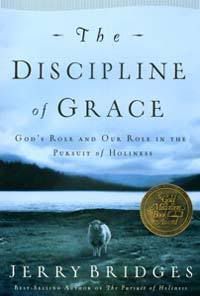
I'm really enjoying reading Jerry Bridges' book The Discipline of Grace. He beautifully lays out a biblical view of the balance between discipline/obedience and grace. One aspect I've found very helpful so far is his exhortation that we not only need to "put off" sin, but we also need to "put on" Christ as well as the associated positive attributes. It's not enough to not steal; you need to be generous. It's not enough not to be angry; you need to be gracious with others.

I found this re-stating of 1 Corinthians 13:4-5 very helpful in my pursuit of loving others well (page 39):
  • I am patient with you because I love you and want to forgive you.
  • I am kind to you because I love you and want to help you.
  • I do not envy your possessions or your gifts because I love you and want you to have the best.
  • I do not boast about my attainments because I love you and want to hear about yours.
  • I am not proud because I love you and want to esteem you before myself.
  • I am not rude because I love you and care about your feelings.
  • I am not self-seeking because I love you and want to meet your needs.
  • I am not easily angered by you because I love you and want to overlook your offenses.
  • I do not keep a record of your wrongs because I love you and "love covers a multitude of sins."
This is the model of love we should strive for.

Thursday, February 12, 2009

"For Better or For Worse, In Sickness and in Health..."

With Valentine's Day in a couple days, wanted to share this story from the New York Times. Dana Jennings has been battling prostate cancer and offers his candid observations about how his wife has thoroughly lived out her wedding vows. I thought this was great. Read the whole thing. It's worth it.

These days, I epitomize the “in sickness” part of the wedding vows that Deb and I took back in 1981. Since we learned last April that I have prostate cancer, I’ve had my prostate removed, found out that the cancer was shockingly aggressive, undergone a 33-session course of radiation and am finishing up hormone therapy.

Right now, I’m not quite what you’d call “a catch.” I wear man-pads for intermittent incontinence, I’m a bazaar of scars, and haven’t had a full erection in seven months. Most nights, I’m in bed by 10. The Lupron hormone shots, which suppress the testosterone that can fuel prostate cancer, have sent my sex drive lower than the stock market, shrunken my testicles, and given me hot flashes so fierce that I sweat outdoors when it’s 20 degrees and snowing.

Even so, Deb has taught me that love is in the details. Humid professions of undying love and tear-stained sonnets are all well and good, but they can’t compete with the earthy love of Deb helping me change and drain my catheter pouches each day when I first came home from the hospital.

Yes, in the details. She measured my urine, peered into places I couldn’t (literally and figuratively), and strategically and liberally applied baby powder, ice and Aquaphor to my raw and aching body. She battled our intractable insurer, networked, tracked down the right doctors — and took thorough notes all the while.

I was wounded. She protected me. She chose to do these things.

Deb and I have been married for 27 years, have two sons (22 and 19), and have ridden the usual Ferris wheel that comes with a long marriage. But our love for each other has deepened in this time of prostate cancer.

We talk more often about the life we’ve built together, about sex and money, about the joy we take in our sons, about the uncertain future. When cancer moves in, there’s nothing you and your spouse can’t talk about.

Our love has been seasoned with a bitter pinch of mortality, and the classic quarrels of marriage hold little power over us anymore. When I say to Deb, “I love you,” I mean it. And when she responds, “I love you more,” she means it, too. We understand that time, perhaps, is not on our side.

Time, we are told, will give us our sex life back. As I said, the hormone shots have shut down my sex drive. And my poor penis is still in recovery — from the surgery and the radiation. But as we wait, I’ll tell you this: Love abides.

Yes, yes and yes — lust is essential. But right now, sex seems quaint, old-fashioned. Oddly enough, it can’t compete with the depth and gravity of a light touch, a sly glance. I’m in the mood for the Beatles and “I Want to Hold Your Hand,” not Grace Jones growling, “Pull up to my bumper, baby.”

Don’t get me wrong. I really, really like sex. But given a choice between the mere biology of lust and the deep soul of love, I’ll take love. My body has changed — but my doctors say my libido will be warming up again before I know it. Deb understands, and we’ve adapted.

Deb’s love is one to live up to, one to reciprocate. Who else is going to snuggle up to me on the couch, smile, listen — and nod knowingly — as I complain about my hot flashes?

In the long shadow of prostate cancer, I’ve learned that I married the right woman.

HT : Kevin DeYoung and First Things

Wednesday, September 17, 2008

Pulpit Magazine on Piper, Driscoll, and Language

(No, Driscoll isn't punching Piper. He's giving Matt Chandler --not pictured -- a fist-pound because of something awesome Piper said.)

It's really no secret that I am a fan of Mark Driscoll's ministry. I watch most of his sermons on his vodcast, and I've read all of his books and am really looking forward to his new one, Death by Love. Even more than Driscoll, I would say John Piper is the author/pastor who has had the most impact on my life. I've read many of his books and his passion for the Lord and his articulation of the gospel is a main reason why I'm a christian today.

At Piper's upcoming Desiring God Conference, "The Power of Words and the Wonder of God," Mark Driscoll will be speaking on the topic, “How Sharp the Edge? Christ, Controversy, and Cutting Words."

Nathan Busenitz over at Pulpit Magazine has written a thoughtful piece on the interesting choice of Piper to have Driscoll speak on this topic. Driscoll is known for his edgy, sometimes offensive humor to make his points, and Piper has given him the task of defending this. Busenitz points out some comments Piper made to Doug Wilson back in 2000 about cutting, sarcastic humor and notes that it's interesting that Piper would invite Driscoll to speak on this topic. Busenitz of course points out Ephesians 4:29, Ephesians 5:4, and Titus 2:6-8.

While I love Driscoll and think he is doing a lot of great work, I tend to agree with Busenitz's article that Mark goes too far with some of his comments. Some seem to be simply for effect, and while they are funny and get the point across, the sentiment could be expressed with a much gentler and more compassionate spirit. Sometimes, they are just downright vulgar.

It is noted, however, that their appears to be a Paul/Timothy type of relationship formed between Piper and Driscoll (it seems to be the same with Driscoll and C.J. Mahaney). I've noticed that over the past 6 months or so, Driscoll has toned down some of his comments and seems more gracious when pointing out flaws in others. His Q&A session at his conference was very telling. He admitted that he needed to work on his pride and noted that he has been convicted of some of his uses of humor and shock-jock comments in the past. I think Piper and Mahaney have influenced him greatly here, and I think this is a main reason why Piper asked him to speak at the conference. Is there a place for this type of language? Piper is forcing Driscoll to think through this again, and with the growth that appears to be happening with Mark, I think it will be a great message.

---------------------------------------------------------

Here is the video from Desiring God's website with Piper explaining why he asked Driscoll to speak.


And here's Driscoll on the Truth/Love balance in a teaser video for the conference:

Monday, April 28, 2008

Love is Not a Fight

Warren Barfield, one of my favorite Christian singers (also one of my wife's favorites) has a new CD coming out May 20th. This is the first single off that album, called "Love is not a fight."

Love is not a place
To come and go as we please
It's a house we enter in and then commit to never leave
So lock the door behind you
Throw away the key
We'll work it out together
Let it bring us to our knees...

Love is not a fight, but it's something worth fighting for...


Leah, by God's grace, I will do everything I can to love you right for the rest of our lives.
Related Posts with Thumbnails